Diminishing legacy of Dr. Sarathchandara and arrival of the ‘outsiders’
August 24, 2012, 7:38 pm
by Ariyawansa Ranaweera
The cultural and social upheaval of 1956 was not something that occurred all of a sudden. Their genesis could be traced to the struggle for independence, Anagarika Dharmapala’s crusade for national revival. But that year was a watershed in that the long suppressed emotions of the people on politics, social and cultural spheres exploded
The natural outcome of this phenomenon is that the arts and crafts of the country were also suffused with tremendous enthusiasm. Drama was one such area where this impact was strongly felt.
The era of the Nurti and Nadagam was on the wane not only because creative minds behind those productions had disappeared by then, but also because the newly emerging intelligentsia were asking for an entirely different kind of entertainment. The song-and-dance performances with very weak story lines were getting stale and moribund.
The new audience with bilingual capabilities was looking forward to a new kind of drama where entertainment was to culminate in edification. The first batch of indigenous language products entered the universities in 1960. Higher education syllabuses accommodated texts to delve into theatrical aspects of drama. Nadagam and Nurti mainly catered to the urban workers and the nascent merchant class. But the taste of the new audience was classical and refined rather than overtly popular. It was this need that was catered to by Dr. Sarachchandra's brilliant products such as Maname and Sinhabahu. They were well received in all parts of the country and have left an indelible land mark on the Sinhala drama tradition.
But, we have to pause here and ask ourselves a very pertinent question regarding the future of Sri Lankan drama. Was there anyone among the contemporaries of Dr. Sarachchandra or others who could build on his style of drama? Sadly, the answer is an emphatic ‘No’. Those who tried their hand at producing dramas a la Dr. S failed. The songs, the steps, the music of Dr. S’ dramas were only the outer layers which, no doubt, contributed immensely to the overall effects of his plays. But in each and every play of Dr. S, be it a tragedy, comedy or a satire, there was an inner substance, a holistic message about human nature that was highly important. It was this dramatic kernel that the imitators of Dr. S. have failed to grasp.
Maname is more than an interesting narrative with glamourous scenes and tragic movements; it is a complex study of the feminine mind in a milieu of male domination. Sinhabahu emanates a myriad strange of emotions which have been discussed at length. Take one of his later dramas. Swarnahansa is a study of the rapacious market forces which propelled by greed subjugates all human relations to filthy lucre. In fact, this drama is an extension of that book ‘Darmishta Samajaya’ which sent jitters through the new advocates of open economic in 1977.
Here is an interesting aside. The 1966 batch at the University of Peradeniya, recently organised a public show, Hanthana Nimnada, to honour Dr. S. and the other dramatists spawned by him. To their utter surprise they discovered that Peradeniya University had not produced a single dramatist after 1978. The fountain seems to have run dry.
What were the reasons for the inability of other dramatist to build on the edifice created by Dr.S? I think one main reason is the sheer genius of the man. Here was a person who possessed a very sound educational background which had been enriched both by the Eastern and Western streams of knowledge. He was a philosopher well versed in both Buddhist theory of perception and Bergsonian philosophy. He caught the sense of the time with an ability to write, besides plays, the age in which he lived in the Eliotic sense.
His knowledge in Sri Lankan folk drama, folk lore and the myths was deep. He imbued the dramatic styles of both the Sanskrit tradition and other oriental traditions. A deep sense of music, dance and prosody enhanced his overall abilities. All these skills helped him to write memorable drama scripts and make them ‘dazzle’ on the stage.
Even if you observe the world scene this situation is not unnatural. After all, man has been producing dramas continuously form the era of Greek plays. But how many world renowned play rights they have produced? Only a handful! Elymer Maude, renowned a drama critic, in one of her essays has mentioned that there have been only five world class dramatists. They are a three Greek tragedians, Aeschylus, Sophocles, Euripides, then Shakespeare and in the modern era only Henrick Ibsen. One may not agree with her totally, but the essential argument is clear. The dramatist with all the necessary ingredients is a very rare product indeed! So is the case with Dr.S. in Sri Lanka. No other Sri Lankan dramatist could reach that high pedestal.
Unfortunately, dramatic style of Dr.S did not become a live force, which could be studied by later generations. Sarachchandra sought perfection. He experimented in the 1930s with the realistic dramas of the day. Then he took to folk drama. Through Maname and Sinhabahu he transcended the Nadagam style of drama. Premati Jayati Soko was an attempt to forge an oriental Opera. He would have gathered ample experience through this voyage. But as mentioned by Dr. M. Fernando in his speech delivered at Peradeniya, on the 50th Anniversary of Sinhabahu, Dr. S never committed such experiences to writing.
If one looks at the Western drama scene, dramatist like Stainslawsky, Meyarhold, Peter Brooks, Grotowski, Antonin Artaud, wrote down their methods of acting and stage craft systematically for others to follow. This did not happen as far as Dr. S was concerned. Was this another reason that his successors could not pick up a thread form where Dr. S left it.
It is in this setting that one has to examine the role of the young ‘hot- heads ‘ led by Sugathapala de Silva. When they entered the drama scene, Sinhala stage was all agog with ‘Manamania’ there was practically no room for any other form of drama.
A book which inspired this group substantially was Colin Wilson’s ‘The Outsider’. A land mark revelation where ‘nobodies’ form the society became ‘somebodies’, adorning the fields of religion, politics and arts. The most noteworthy feature of all these characters was that they were the fore-runners who broke the stranglehold of feudal hegemony in these fields during the 19th and 20th century in Europe. There was and uncanny resemblance between these European characters and the ‘outsiders ‘ who championed a new thrust into the art world of Sri Lanka in the 1950s. Some of them are Ralex Ranasinghe, Tony Ranasinghe, Wickrama Bogoda, Prema Ranjith Thilakarathne, Benedict Dodampegama and Cyril B. Perera. Majority of them did not have university education. They all came form lower middle class background. They were a Bohemian lot, for most of them did not have regular employment. But all of them had one distinctive advantage. For, they were bilingual products. They were highly attuned to new winds that were blowing across the Western hemisphere.
Their focus was not only on drama but also all avant-garde interventions that were taking place. They immersed themselves in works of Satre, Camus, Andre Gide, Hemingway, Gertrude Stein, a wave of films of Vitorio De Sica, Fedrico Felini, Ingmar Bergson, Roaman Polansky, dance forms of Martha Graham, Isadora Dancan and new poetry of French Symbolists, T.S. Eliot and Ezra Pound. They also admired the abstract art of Picasso, Kandinsky, Gaughan, and Van Goh. In other words, they were fallowing faithfully all the activities of the ‘’Lost Generation’’ of the 1930s.
Thus it is clear that these new entrants were not a group of mere experimenters without sound roots. They had the confidence and daring of their new found intellectual grounding. They presented an alternative dramatic style different form that of Dr. S. In fact there was a healthy competition between these two genres in the 1960s.
There is another extremely important fact that should be taken into account when studying the impact on indigenous drama by these new comers. They were not introducing the brand of realistic drama propounded by Ibsen, Chekhov, Strindberg, and Bernard Shaw. The plays of these dramatists, though revolutionary when they were first introduced, lacked novelty by the 1960s. The drawing room, closet drama where picture perfect reality and endless dialogues were found inadequate to grasp the facets of a drastically change world.
The belief in man’s perfectibility had been shattered especially by the onset of first and second world wars. The underlying belief in the early realistic drama was that in spite of all social ills that stalked the human beings, the rational side of the man could overcome them if they were properly guided. The two wars and the attendant miseries gave the lie to that grand notion. The wars proved that intellect would not save the human beings. They were inherently prone to animal passions, greed, aggrandizement, torture and massacre.
This new ‘mental frame’ gave rise to a more pessimistic view of human nature. Dadaism, Anarchism, and Existentialism became the creeds of the post-war generations.
Drama was also caught up in this transition. The realistic drama which gave preference to the ‘human word ‘ was found inadequate to articulate this new human condition. Dramatis were in search of new modes of dramatic art. Three strands of drama emerged eventually due to these efforts over time. Drama of the Absurd, whose major proponents were Becket, Lonesco, the expressionists , whose ranks were strengthened by dramatists like, Luigi Pirandello, Tennessee Williams, John Osborne ( ‘’Of Look back in Anger’’fame) and, of course, the epic drama championed by the Germans, Irvin Piscator and Bertolt Brecht.
Although these three types of drama possessed their individual characteristics, what is common to all three is that they went beyond the orthodox realist drama towards a Surrealistic approach. They called that a search for ‘’total theatre’. First introduced by Antonin Artough the French Surrealistic playwright and rebel through his ‘’Theatre of the Cruelty’ was an invocation of the total body rather than only the mind of the spectator. For this they went back to the early theatre of human beings in search of inspiration. Usage of masks, dance steps, incantation, articulation of nonsense words, enlargement of dramatic props were some of the ploys they used in their dramas.
Martin Esslin in his land mark book, ‘’Theatre of the Absurd’, has this to say on this development: "The theatre of the absurd is a return to the old, even archaic traditions. It’s novelty rise in its somewhat unusual combination of such antecedents and a very survey of these will show that what may strike the unprepared spectator as iconoclastic and incomprehensible innovation is in fact merely an expansion , revaluation and development of procedures that are familiar and completely acceptable in only slightly different contexts.’’
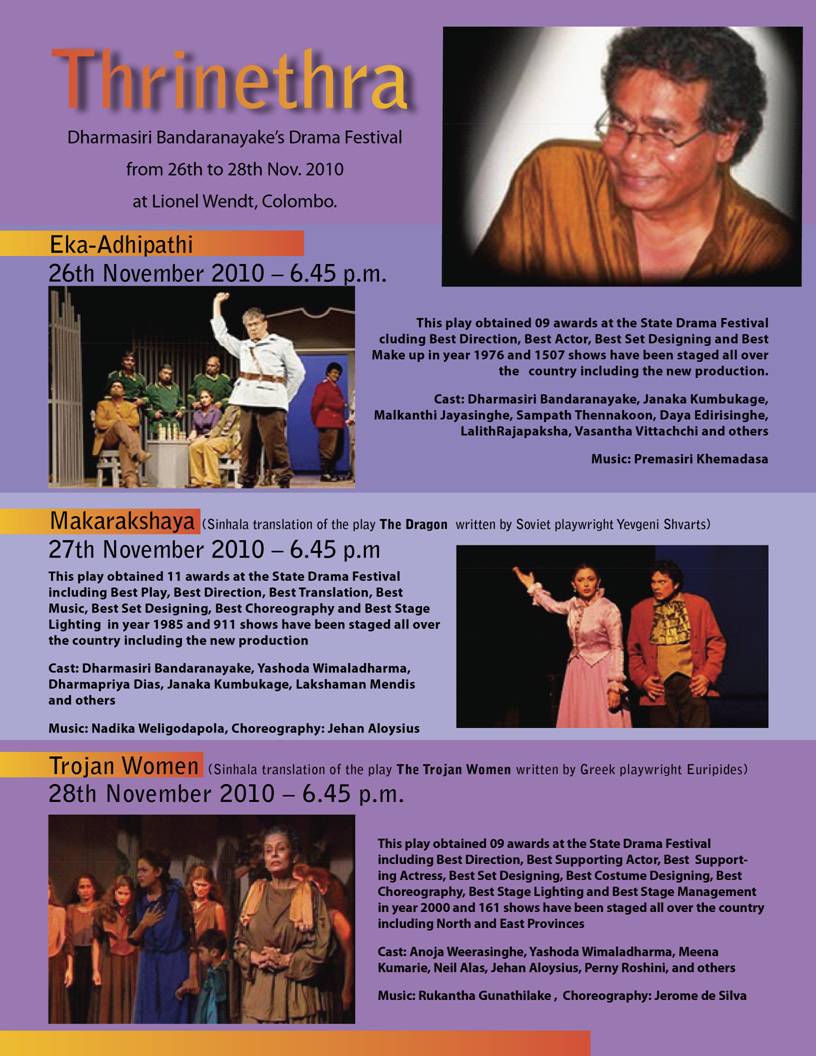
It was these plays with more action and magic rather than ‘verbiage’ that Sugathapala de Silva and his colleagues presented to the Sri Lankan audience. In fact, all three types of new drama were produced by those new comers.
Sugathapala de Silva in the introduction to his ‘Mara Sade’ translation attempts to articulate his approach to drama. ‘’Realism should not be narrowed down to superficial realism. One has to go deeper and come close to Surrealism. This is an attempt by the dramatists to grasp the subtleties of human behavior. Psychology enters modern drama. Psycho analysis takes you to ritual and magic. There are demons to be appeased and there should be Sharman’s to do this.
We have a distinct advantage that was not there before the early dramatists. World has become narrower and sources of knowledge are readily accessible. We should not be afraid to be influenced by these sublime dramas and dramaturgy at all. Those who run a way form salutary influences confess their barrenness of their souls ‘’
And unending array of these new dramas appeared on our stage, mainly as translations and adaptations Attempts were made to produce original dramas based on these principles though not with the same success. Gradually these new dramas started wining prizes at the drama festivals. Slowly and surely they gained ascendency on our stage, replacing stylistic dramas introduced by Dr. Sarachchandra.
Courtesy: The Island